
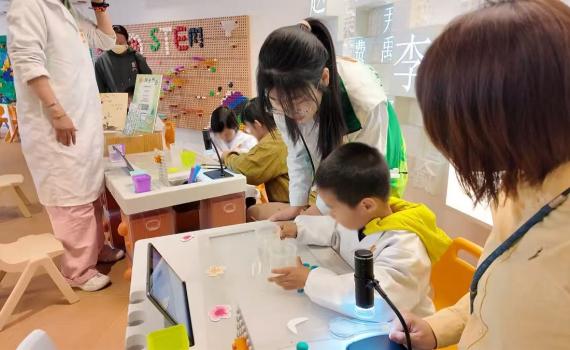
"What this programme has given us goes beyond fostering scientific thinking — it's taught us a new way of bonding with our child," said a parent whose child participates in the Shanghai Children’s Library ‘STEM Whiz Kids’ programme.
Launched in 2023, the ‘STEM Whiz Kids’ programme was designed to tackle obstacles to early education in STEM subjects. “Despite strong parental willingness to invest in education, the uneven distribution of quality STEM (Science, Technology, Engineering and Mathematics) resources and the high cost of private courses create a significant barrier for many average families,” says Zhong Kangrui, the the librarian in charge of the ‘STEM Whiz Kids’ programme.
The ‘STEM Whiz Kids’ are children aged from three to six. The programme is delivered to the community free of charge, removing the financial burden from families.
Zhong also highlighted another challenge. In many families, both parents must go out to work, leaving their children in the care of grandparents who often do not have the knowledge and technical skills needed to support modern STEM education.
“Through proactive, library-facilitated programmes, we empower grandparents and dual-income families to overcome educational barriers. This approach fills a key gap in early science exposure and repositions public libraries as the community cornerstone for accessible STEM learning,” says Zhong.
How the children learn
The ‘STEM Whiz Kids’ programme employs a blended pedagogy of guided reading, interactive learning experiences and hands-on practice with digital technology.
“Our 190-square-meter STEM Space features seven dedicated zones: the LEGO Construction Zone, Light & Shadow Room, Outdoor Exploration Zone, MINI LAB, Sensory Wall Reading Nook, Saturn Explorer Zone, and Movable Type Printing & Light Play Zone. Here, abstract scientific concepts become tangible, interactive encounters for children, brought to life by digital tools like Sphero robots, digital microscopes and hands-on experiment kits,” says Zhong.
The STEM education framework rests on three pillars: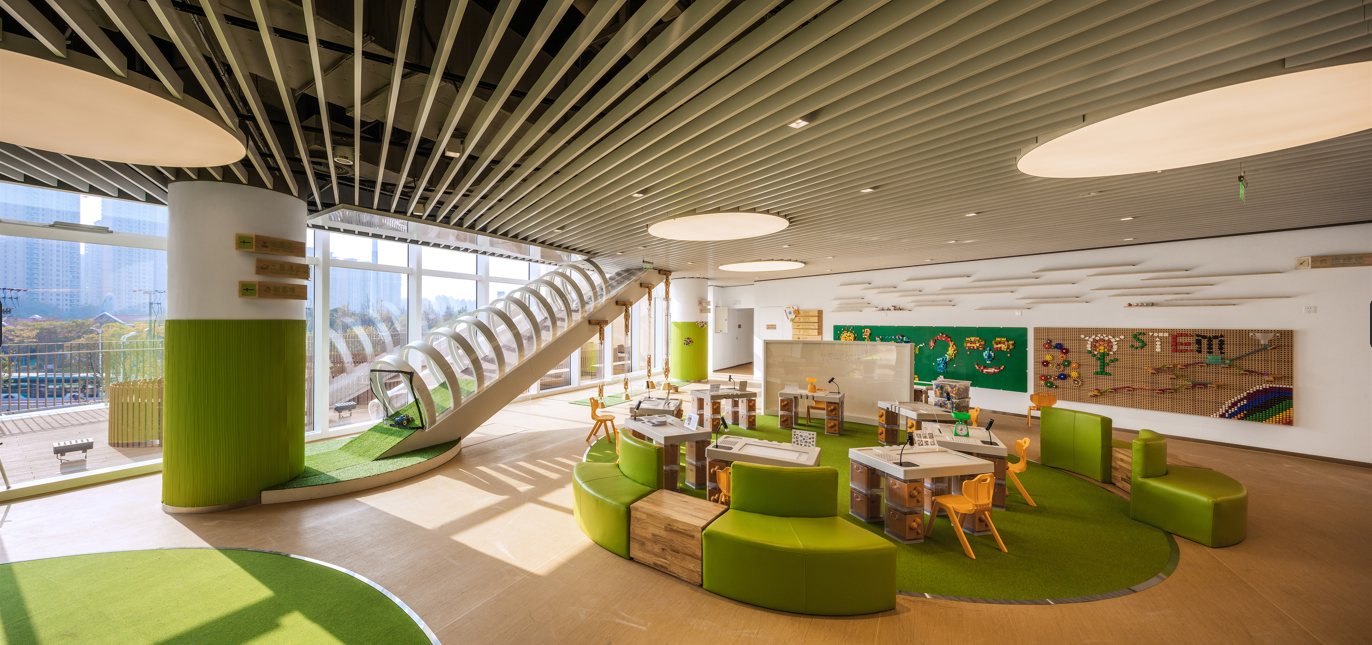
Age-Specific Learning Pathways:
- Children aged 3-4 learn through sensory exploration, with tactile walls and sensory bins filled with materials such as rice, beans, sand, water, or shredded paper, plus objects like scoops and toys, designed for children to explore through touch, sight, and sound for foundational cognition.
- Children aged 4-5 engage in cause-and-effect enquiry, learning through guided experiments like magnetism and color mixing.
- Children aged 5-6 engage in project-based challenges, including building simple machines and introductory coding.
A Gamified Motivation System:
- On completing tasks, children earn rewards to foster motivation and a sense of achievement, for example, cards, stamps and ‘Little Scientist’ badges.
Integrated Digital Resources:
- Using tablets, each lesson is enriched with science animations and interactive e-books, facilitating immersive multimedia learning.
Picture books for exploring science
The programme begins with reading. “We have built a structured STEM reading resource system. For each unit, such as ‘The Mysteries of Plants’ or ‘The Science of Light and Shadow’, we provide a collection of eight to 10 picture books that explore scientific principles, experimental procedures and the humanistic aspects of science. This creates a robust knowledge framework, preparing children for hands-on experimentation,” says Zhong.
To connect with families in the wider community, the library sets up ‘STEM Corners’ in neighbourhood cultural centres for pop-up workshops. The library also collaborates with kindergartens to deliver curriculum resources and has established a pop-up mobile ‘Nature Discovery Base’ in Shanghai’s centrally located Changfeng Park.
From 2023 to 2025, the ‘STEM Whizz Kids’ programme conducted 229 activities with 10,751 participants. Thematic book displays reached an audience exceeding 100,000, and book loans on STEM subjects have increased. “Notably, 70% of young attendees were from neighbourhood dual-income families, and 40% were most often accompanied by grandparents – underscoring our targeted impact on communities with limited resources,” says Zhong.
‘The most popular service in the community’
"The library's programme is hands-down the most popular service in our community now," said a director in the Changfeng Community Office. "We had nothing like it for pre-schoolers before. It’s been a game-changer – enriching our community offerings, easing the science education load on families, creating new links between neighbours, and fulfilling a deep-seated need."
"I didn't get much schooling myself, so I used to just focus on keeping my grandchild fed and safe. But coming to the library has taught me how to do simple science experiments with her in a way we both get. Now I can even explain things like maglev (magnetic levitation) trains - it's amazing!" said a grandparent.
"My child used to be afraid of science, but now can't wait to explore it and insists on a science book every night," a parent shared.
“The ‘STEM Whiz Kids’ programme is forging warm connections across generations and helping to narrow educational disparities,” says Zhong.
More public and community libraries supporting education.
PLIP-Education


