
For public libraries advancing community Artificial Intelligence literacy skills
The deadline for applications is Monday, 26 October, 2026.
Public libraries are playing an increasingly important role in helping people to navigate today's complex information landscape. Today, this includes helping people to understand and use artificial intelligence (AI) by providing AI literacy education.
The 20th EIFL Public Library Innovation Award call aims to recognize outstanding and innovative public and community library AI literacy training programmes that help people advance their technical skills, think critically about AI outputs, and use emerging technology responsibly and safely.
Public and community library AI literacy training programmes may be provided in-person or online, and tailored for people of different ages and abilities, or with different needs. AI literacy training programmes can be standalone courses, or integrated into existing media and information literacy programmes. They can target the community broadly, or specific groups, for example, youth, women, students, farmworkers, children, seniors or people with disabilities. Libraries may collaborate with universities, non-governmental organizations (NGOs), or other partners to provide quality AI literacy training in their communities.
Here are a few examples of AI training activities in public libraries from different countries -
- Ghana Library Authority's Central Regional Library runs a digital learning workshop for high school students to provide them with practical AI skills for learning, using ChatGPT. During several sessions, learners develop a general understanding of how AI works and how to interact with and build prompts for ChatGPT, and gain hands-on experience using it for school-related activities and creativity support to advance their education.
- Esperance Public Library in Australia hosts free community workshops on AI and misinformation aimed at teaching practical skills for questioning, verifying, and navigating online information, and spotting AI-manipulated content, including synthetic media and deepfakes. The two-hour sessions are free and offer a variety of engaging activities, including brief presentations, group discussions, hands-on activities, and take-home resources.
- Toronto Public Library in Canada has started a city-wide initiative to equip residents, especially from marginalized communities, with AI skills. The library also makes AI tools and resources that normally require subscription available free of charge. Librarians lead learning circles (study groups) on ‘Google AI Essentials for Beginners’ and ‘Google AI Prompting for More Experienced Learners’. Eight to 10 hours of training spread over two to four weeks provides learners with practical skills that they can immediately apply in day-to-day work and advance their employment opportunities
- Klaipėda City Public Library in Lithuania launched a creative initiative for young people dedicated to the Year of Simon Dach, a prominent 17th-century Prussian poet and professor who was born in Klaipėda (Memel). Young people learned to use Midjourney, a generative AI tool that creates images from text descriptions, to create modern visual interpretations of the poet’s works. Collaboration with the Klaipėda Technology Training Center and other experts led the library to an innovative approach to developing practical skills that combined literature, cultural history, art, and technology.
WHAT WILL YOU WIN?
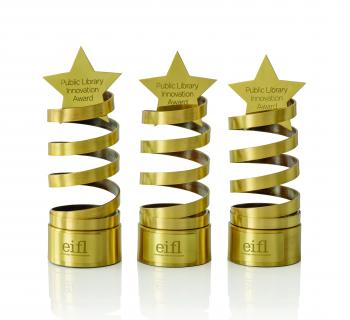
- Each winner will receive a trophy, and a prize of US$1,500.
- International publicity – EIFL will share your story widely through its publicity channels.
WHO MAY ENTER?
To enter the competition, you must meet all of the following criteria:
- You must be a public or community library.
- The library must be in a transition or developing economy country [pdf].
- The programme/activity should be new, i.e. started during or after January 2024.
- The programme/activity should have been operational for at least six (6) months, and must be operational at the time of application.
- You must provide evidence of positive results of the programme/activity, including statistics regarding the number of people engaged and stories by participants about how the AI literacy training by the library has had a positive impact on their education / work / daily lives.
Note:
We will not accept applications that:
- Seek funding to start new programmes/activities;
- Only offer access to AI tools and resources without a training component based on a well-thought-out approach, content, and tracking of learning outcomes;
- Only provide public access to ICT and general digital skills training.
WHEN CAN YOU ENTER?
This call is now open. The deadline for submitting applications is Monday, 26 October, 2026.
NUMBER OF AWARDS
There could be more than one winner. The number of winners will depend on the quality of applications received.
FURTHER DETAILS AND HOW TO APPLY
Application form: English, French, Russian, Spanish
Signature page: English, French, Russian, Spanish
Rules and guidelines for submission
Evaluation criteria
Frequently asked questions (FAQ)
Online Application Submission