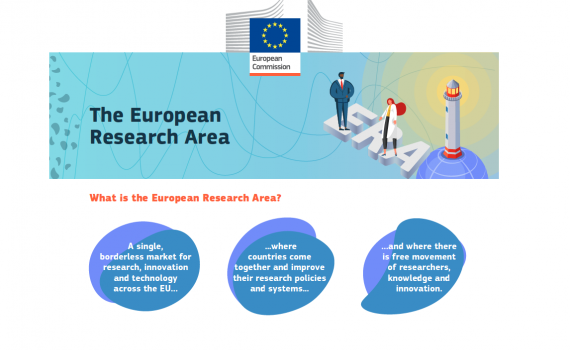
In January 2025, the European Commission announced plans to develop a European Research Area (ERA) Act. In October, the Commission launched a public consultation to collect evidence on issues hampering the full achievement of the European Research Area, a single, borderless market for research, innovation and technology across the EU, along with views from stakeholders on solutions that could be supported by legislation at EU level (the consultation closed on 23 January 2026). The Commission intends to publish its proposal in the third quarter of 2026. EIFL's Teresa Hackett and Iryna Kuchma explain why EIFL is looking forward to the development of the European Research Area Act.
The European Research Area (ERA) Act aims to strengthen Europe’s research infrastructures, mainstream open science practices and align policies, particularly in areas of strategic priority such as climate action, health, and digital technologies. EIFL welcomes the proposal for an Act that, if successful, will help to tackle persistent obstacles to science and research and ensure the free circulation of scientific knowledge in Europe (the so-called “fifth freedom”).
EIFL commented on two specific areas in the European Commission’s public consultation: the free circulation of scientific knowledge and knowledge valorisation.
Free circulation of scientific knowledge
In background information, the Commission noted that despite good progress in promoting open access and open science policies, the proportion of scientific publications and research data available through open access remains well below target. It identified a number of obstacles that impede access to and reuse of research output, such as, legal issues, lack of interoperability of research data, and academic research assessment systems that are based on the quantity of publications in prestigious journals.
In EIFL’s comments on the free circulation of scientific knowledge (section 3.2.2), we highlighted barriers created by copyright. In particular, a European Commission study, ‘Improving Access to and Reuse of Research Results’ (2024) found that 80% of researchers surveyed had problems accessing copyrighted materials, 20% refrained from text and data mining (TDM) activities (despite the Digital Single Market Directive that allows TDM), and 15% avoided knowledge sharing. EIFL believes that the ERA is an opportunity to systematically address these copyright barriers, and it made five recommendations for improvements.
- The research exception in the InfoSoc Directive (Article 5.3(a)) should be made mandatory and it should be harmonized to clearly apply to all types of research. Without a clear, guaranteed right to research, and to share research results, ambitions for an effective European Research Area will remain largely unfulfilled.
- Research exceptions must be protected from licence terms that override or restrict the exercise of statutory rights. For examples of such licence terms, see the COMMUNIA report, 'Unfair licensing practices: the library experience' (2025).
- A mandatory EU-wide Secondary Publication Right (SPR) should be introduced giving authors (or their institutions) the legal right to make their research available, increasing the impact of published research across Europe. For an example of SPR in copyright law, see EIFL’s model SPR provision (Article 8).
- Research Funding Organisations (RFOs) and Research Performing Organisations (RPOs) can contribute in two key ways. All RFOs and RPOs should replicate the approach of Horizon Europe in requiring immediate open access in OA repositories, and in data management plans that operate under the principle ‘as open as possible, as closed as necessary’. They should also support, with budgets and without Article Processing or Article Development Charges, non-profit OA publishing with quality, editorial procedures. Such policy alignment, with strong monitoring mechanisms, will increase access to publicly funded peer-reviewed publications.
Knowledge valorisation
Knowledge valorisation is the transformation of data, know-how and research results into tangible products, services, and knowledge-based policies that benefit society. The Commission noted the growing emphasis on knowledge valorisation, including guiding principles and codes of practice on the management of intellectual assets. However, structural problems that hinder the efficient transformation of research results for the societal and economic benefit persist.
In EIFL’s comments on knowledge valorisation (section 3.2.4), we noted a systemic problem: research in Europe is governed by a maze of laws and regulations spanning multiple and overlapping areas including copyright, software, data, privacy, digital services and AI, none of which has research at its core. As a result, researchers must navigate an ill-suited, complex legal and operational environment just to undertake the work that is expected, and required, of them as researchers - using digital research tools, collaborating with researchers across borders, abiding by funder OA mandates, ensuring wide readership of research outputs and advancing their careers. And when researchers try to assert their legal rights, the unequal bargaining position with publishers often leaves them powerless, uncertain, and fearful of exercising their rights.
By placing researchers front and centre of Europe’s knowledge ecosystem in a coherent and holistic way, the ERA Act can fundamentally change this situation. If successful, the Act will address the power imbalance, embed open science practices across research activities, and align legal, policy and regulatory environments at national and institutional levels. It will help RFOs and RPOs to strengthen their open science infrastructures and services, and ensure capacity building and researcher training. Importantly, it will foster a culture of open science among researchers and provide incentives and rewards for open science practice.
The Act will also speed up reform of the academic research assessment system to reward and incentivise quality, impact and openness over current reward systems that are predominantly focused on publications and citations. It will support diversity of research outputs, activities and missions e.g. FAIR data and metadata, well-documented and reusable research software, protocols and workflows, teaching, mentoring, outreach and engagement of societal actors, including citizen science and public participation.
For all these reasons, EIFL looks forward to the development of the European Research Area Act.
Further reading
SHARE / PRINT


RECENT BLOGS